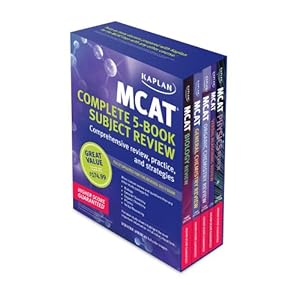
best books to study for mcat image

Ben0013
I have one year until I have to take the MCAT?? What is the best book to study? I have heard about Princeton, Kaplan, Barrons, and a few others. I plan on taking a class regardless (which class is the best to or is it even worth it to take a class?) Thanks. Are there any other ways you guys would suggest studying?
Also, I have heard people can get "burnt out" from starting to study to early. One year is early but I don't want to put it off. I really want to get a great score the first time and never have to deal with that biology, chemistry, bull shit again. Thanks guys!!!!!
Answer
Congrats to becoming a doctor!
Please start studying now
The best MCAT one on the market right now is
Examkrackers Complete MCAT Study Pkg: 5 Book Package
http://tinyurl.com/ofwp7k5
I started studying during my first semester of college
Congrats to becoming a doctor!
Please start studying now
The best MCAT one on the market right now is
Examkrackers Complete MCAT Study Pkg: 5 Book Package
http://tinyurl.com/ofwp7k5
I started studying during my first semester of college
What's an excellent MCAT book to study from?
-. J
I'm a freshman college student, I'm planning on studying an MCAT prep book every summer until my junior year, I would like to know what's a good book to help me?
Thank you!
Answer
First off, It's really great that you are wanting to take the initiative on the MCAT so early.
I think most people would tell you that studying for the MCAT three years before taking the test (or two if you are on an accelerated path) is not very productive because you will not remember stuff you study two or three years when you take the test.
The best way to study for the MCAT now is to do well in the general chemistry I and II, physics I and II, biology, and organic I and II classes and make sure that you are not cramming short term for tests and forgetting the big principles of the class. Make sure you have a long term approach to studying so that you will not have to relearn everything within the three to six months before your MCAT test when people truly start studying for the test. So studying for the MCAT when the appropriate time comes will be a review like it is supposed to be. Also make sure to take physiology at the very least in addition to classes mentioned above. I also would consider genetics, biochem, cell or molecular biology
The best thing you can do for your MCAT score right now is maybe focus on verbal reading skills and reading lots of literature and trying to get the main idea and stuff like that. Verbal Reasoning i feel like is a skill that is developed over time through reading very thick humanities material and philosophical and other stuff. Journals like the New Yorker, time magazine, Nature, Science. and other english literature stuff can really be beneficial.
For more MCAT stuff you can peruse other questions I have answered through my list. For books. I recommend getting Berkeley Review and Exam Krackers (princeton review isn't bad) - all explained in this link
http://answers.yahoo.com/question/index;_ylt=ApfMukaMgvVncizStYhogNfty6IX;_ylv=3?qid=20110512190619AA5NBKE
I also recommend visiting student doctor network which has lots of great MCAT advice.
However I don't think it hurts to keep reviewing material (which is why I have still provided the above link to good review books) in the summers when you are volunteering, researching, shadowing physicians, and doing other extracurricular activities (which is the most important thing you could possibly do to enhance your chances of acceptance); Not to mention I think also to appreciate the time to do fun things and enjoy life because speaking from experience, in medical school the time not spent studying is a rare and precious commodity.
http://forums.studentdoctor.net/archive/index.php/t-465332.html
http://forums.studentdoctor.net/archive/index.php/t-589464.html
Also other things to keep in mind (many years from now for you) is that registering from the MCAT takes a couple months of advanced planning because testing sites are limited and if you wait too long you will end up having to fly to take your MCAT or take a long drive to some remote village in the jungle.
I think you'll probably look skeptically on this advice as I would have when I was a freshman. Someone's telling me not to worry too much so early about the test that determines my life and is telling me to enjoy the undergrad experience. While there is still time to go out and have fun in medical school, that time is very scarce certainly nowhere near the time in undergrad. And while the MCAT is an important factor in admissions remember that grades (GPA which is your work ethic), extracurriculars (well-roundness sports, music (instrument), hobby, etc.), shadowing (knowing what you have gotten yourself into), volunteering (opportunity to help the community) and research (wanting to learn beyond what is written in a book) are strong factors in medical school admission, shadowing and volunteering especially.
ALSO REALLY IMPORTANT. if you want to volunteer make sure you are doing something medically related. Do not sit at a receptionist desk at a hospital. You might as well spend the time earning money while working at walmart. There are probably free clinics, or low cost clinics or meaningful volunteer opportunities you just have to look for them. And usually it takes a couple months for paperwork to be done not to mention everyone will volunteer so the later you look for volunteering the harder it is to come by (especially quality opportunities) So I would ask your pre med advisor or community church people or someone about volunteering to be able to take someone's blood pressure, get their blood glucose level, getting their other vitals like pulse or temp.
Wow I totally digressed on this answer; Books are in the link; though best advice is to focus on verbal.
First off, It's really great that you are wanting to take the initiative on the MCAT so early.
I think most people would tell you that studying for the MCAT three years before taking the test (or two if you are on an accelerated path) is not very productive because you will not remember stuff you study two or three years when you take the test.
The best way to study for the MCAT now is to do well in the general chemistry I and II, physics I and II, biology, and organic I and II classes and make sure that you are not cramming short term for tests and forgetting the big principles of the class. Make sure you have a long term approach to studying so that you will not have to relearn everything within the three to six months before your MCAT test when people truly start studying for the test. So studying for the MCAT when the appropriate time comes will be a review like it is supposed to be. Also make sure to take physiology at the very least in addition to classes mentioned above. I also would consider genetics, biochem, cell or molecular biology
The best thing you can do for your MCAT score right now is maybe focus on verbal reading skills and reading lots of literature and trying to get the main idea and stuff like that. Verbal Reasoning i feel like is a skill that is developed over time through reading very thick humanities material and philosophical and other stuff. Journals like the New Yorker, time magazine, Nature, Science. and other english literature stuff can really be beneficial.
For more MCAT stuff you can peruse other questions I have answered through my list. For books. I recommend getting Berkeley Review and Exam Krackers (princeton review isn't bad) - all explained in this link
http://answers.yahoo.com/question/index;_ylt=ApfMukaMgvVncizStYhogNfty6IX;_ylv=3?qid=20110512190619AA5NBKE
I also recommend visiting student doctor network which has lots of great MCAT advice.
However I don't think it hurts to keep reviewing material (which is why I have still provided the above link to good review books) in the summers when you are volunteering, researching, shadowing physicians, and doing other extracurricular activities (which is the most important thing you could possibly do to enhance your chances of acceptance); Not to mention I think also to appreciate the time to do fun things and enjoy life because speaking from experience, in medical school the time not spent studying is a rare and precious commodity.
http://forums.studentdoctor.net/archive/index.php/t-465332.html
http://forums.studentdoctor.net/archive/index.php/t-589464.html
Also other things to keep in mind (many years from now for you) is that registering from the MCAT takes a couple months of advanced planning because testing sites are limited and if you wait too long you will end up having to fly to take your MCAT or take a long drive to some remote village in the jungle.
I think you'll probably look skeptically on this advice as I would have when I was a freshman. Someone's telling me not to worry too much so early about the test that determines my life and is telling me to enjoy the undergrad experience. While there is still time to go out and have fun in medical school, that time is very scarce certainly nowhere near the time in undergrad. And while the MCAT is an important factor in admissions remember that grades (GPA which is your work ethic), extracurriculars (well-roundness sports, music (instrument), hobby, etc.), shadowing (knowing what you have gotten yourself into), volunteering (opportunity to help the community) and research (wanting to learn beyond what is written in a book) are strong factors in medical school admission, shadowing and volunteering especially.
ALSO REALLY IMPORTANT. if you want to volunteer make sure you are doing something medically related. Do not sit at a receptionist desk at a hospital. You might as well spend the time earning money while working at walmart. There are probably free clinics, or low cost clinics or meaningful volunteer opportunities you just have to look for them. And usually it takes a couple months for paperwork to be done not to mention everyone will volunteer so the later you look for volunteering the harder it is to come by (especially quality opportunities) So I would ask your pre med advisor or community church people or someone about volunteering to be able to take someone's blood pressure, get their blood glucose level, getting their other vitals like pulse or temp.
Wow I totally digressed on this answer; Books are in the link; though best advice is to focus on verbal.
Powered by Yahoo! Answers


 Posts
Posts



Comments :
Post a Comment